
Wyoming City Directory Collections
Grand Rapids Public Library is the key regional shelf for Wyoming city directories. Its holdings separate Grand Rapids editions from suburban and county editions, which matters because Wyoming developed outside the Grand Rapids city limits and later became a city. Start by matching the volume title to the place and period being researched. The library list also preserves gaps in the R.L. Polk sequence, so an absent edition should never be treated as an absent person.
| Collection | Years | Where Held | Access |
|---|---|---|---|
| Grand Rapids city-directory microfilm | 1856–1956 | GRPL History & Genealogy holdings | Library microfilm |
| R.L. Polk directories | 1859–1998, with gaps | GRPL print and microfilm list | Library holdings |
| Grand Rapids Suburban Directory | 1957–1997 | GRPL | Regional directory collection |
| Kent County East/West directories | 1998–present listed | GRPL county collection | Library holdings |
| Williams Grand Rapids Directory | 1859/60 | Grand Rapids History Center | Archive finding aid |
| Dillenback & Leavitt directory | 1870 | Library of Congress digital collection | Free online resource |
The R.L. Polk list records no publications for 1947, 1950, 1952, 1957, 1989, and 1991. Check the edition before and after one of those gaps, then look to a deed, newspaper, or other dated source for support. The GRPL directory holdings list is the right starting catalog because it names the collection and its format.
Wyoming’s Suburban Directory Boundary
The Grand Rapids Suburban Directory is the most useful Wyoming bridge. GRPL describes it as covering Kent County outside Grand Rapids city limits from 1957 through 1997. That boundary is a real research feature, not just a title difference. A Wyoming household may be missed by an edition limited to Grand Rapids while appearing in the suburban run for the same broad period.
Wyoming was incorporated as a city in 1959 from the township. Earlier material can therefore use township or county context rather than a present-day city label. Record the place wording exactly as printed, then compare the street and municipality before connecting an entry to modern Wyoming. A city-directory search is stronger when the title-page geography, street, and household information point in the same direction.
Wyoming City Directory Gaps
Publication history creates a comparison problem. The R.L. Polk sequence reaches from 1859 to 1998, but its documented missing years break a simple year-by-year trail. A surname can appear in 1946 and then again in a later available volume without proving when the household moved. The same caution applies when a house number is new, a street is outside the edition’s stated scope, or a household head was not listed.
Use a short evidence log with the edition year, title, publisher, page, name as printed, street spelling, number, owner or renter notation, and the reason for any uncertainty. This turns a gap into a visible limit instead of an invented event. Note: The listed no-publication years are collection gaps, not evidence that Wyoming residents or addresses disappeared.
Reading a Wyoming City Directory Entry
A directory entry is a compact, dated record. In surname sections, an entry can carry an occupation, other household members, ownership information, and a street address. Street sections normally arrange results by street and then house number. Phone sections may be numerical and centered on the head of household. Preserve initials and abbreviations rather than expanding them from guesswork.
| Name | Record the surname, given name, initials, and spelling exactly as printed. |
|---|---|
| Household note | Capture any spouse or other household-member reference supplied by the edition. |
| Street field | Keep the house number and street spelling, then inspect entries immediately before and after it. |
| Owner or renter mark | Retain the edition’s notation; it is a historical field, not proof of title. |
| Phone or cross-reference | Copy it only when shown, along with the page and directory year. |
- Criss-cross directory
- A reverse section arranged by street and house number that can identify a listed household at an address.
- Householder index
- A name-oriented listing that commonly centers on the head of a household rather than every person present.
- Abbreviation key
- The volume’s explanation of its marks and shortened words; photograph or note it before interpreting an entry.
Wyoming City Directory Street Searches
Later city directories can be read two ways. Find the surname entry first when a name is known, then turn to the street or criss-cross section to test the house number. For an address-first question, start in street order and compare nearby numbers. A first-at-address indicator, new-arrival note, or relocation mark is a lead for the next edition, not a conclusion by itself.
Directories are particularly useful for a household trail because a deed records title while a directory records a published household snapshot. The current street chain belongs on the Wyoming Streets page; historic volumes work best after the address and its old spelling have been stabilized. Check the title page and the abbreviation key every time a publisher changes.
Wyoming’s Early Directory Starting Points
Two early resources establish regional context without pretending to be a complete Wyoming resident roll. The Grand Rapids History Center has a finding aid for the 1859/60 Williams directory, and the Library of Congress provides a digitized 1870 Dillenback and Leavitt directory. They can help with early county and Grand Rapids names, local businesses, and geographic wording.
Neither source should be used to manufacture a named Wyoming example. The research record did not verify a legible Wyoming resident line in the unattended review. Preserve the edition, page, and location language from the scan, then pair any apparent address with a later directory, atlas, or county record. The History Center finding aid and the 1870 digitized directory provide separate access paths.
GRPL Access for Wyoming Directories
Grand Rapids Public Library combines the directory shelf with genealogy databases, newspaper tools, obituary materials, and local-history guidance. American Ancestors and Ancestry Library Edition are described as in-library resources. FamilySearch Affiliate is available on Main Library computers, Fold3 is listed at Main Library, NewsBank and the Grand Rapids Press have library-card access, and MyHeritage has library-card access. Confirm the relevant access rule before making a special trip.
GRPL’s genealogy resource page identifies the access environment behind the collections.

The library resource view supports a layered search: inspect a directory line, then use the available newspaper or obituary material only to corroborate the date and place. KDL reported public computers, Wi-Fi, printing, copying, faxing, and scanning availability in a July 2026 update; branch conditions can change, so verify before travel.
Trace Wyoming City Directories by Year
Build a household timeline one edition at a time. Start with an approximate year and a known address or surname. Then compare the street and surname sections in consecutive available volumes. Pair the directory point with the appropriate census or another dated local source, while keeping ownership and occupancy as separate questions. The Library of Michigan’s Kent County guide adds newspapers, cemetery material, a 1870 census index, church-record indexes, and deed-index leads as possible corroboration.
- Choose the directory whose geographic coverage matches Wyoming, township, suburban Kent County, or a county East/West division.
- Record the edition year, title, publisher, page, exact name string, house number, and every printed notation.
- Check the preceding and following available editions, allowing for the documented publication gaps.
- Use a criss-cross or street section to test whether the same number carries a new household or a spelling variation.
- Corroborate an important change with a dated deed, newspaper notice, obituary file, census record, or official custodian.
A disappearance can reflect a move, death, omission, changed household head, or a volume’s scope. It is not enough by itself to say what happened. Note: Keep title evidence from the deed system distinct from a city-directory listing of a household at an address.
Wyoming Directory Holdings Compared
The collection list makes the contrast visible: city-limit editions, the 1957–1997 suburban run, and later East/West county volumes answer different location questions. This documented comparison is more reliable than treating every Grand Rapids title as a Wyoming city directory. It also explains why a search sometimes needs adjacent editions rather than a single year.
The GRPL holdings record is the source for the years, formats, and recorded gaps shown here.
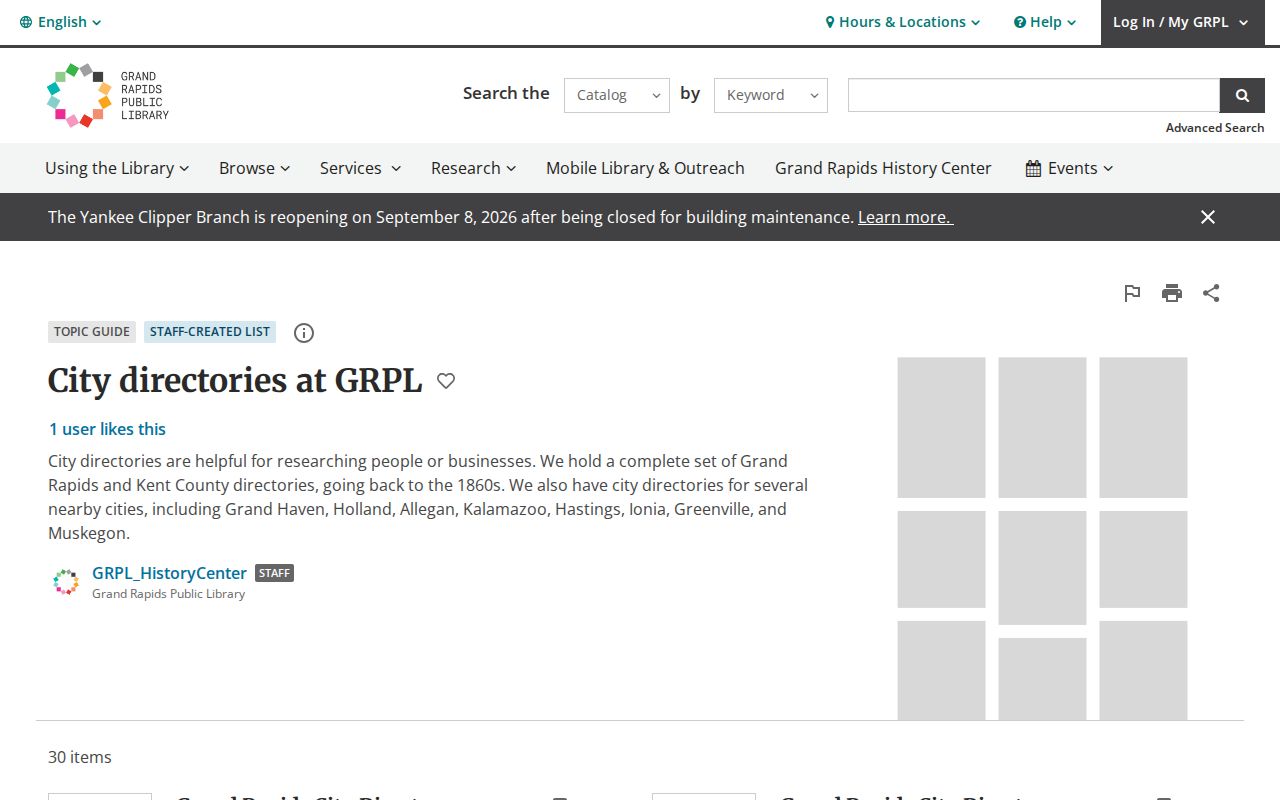
Use the collection description to decide whether a missing result needs a different geographic volume, a nearby year, or an in-library format. The screenshot is a catalog aid, not a substitute for recording the actual directory page used as evidence.
Limits of a Wyoming City Directory
A Wyoming city directory can document that a person or household was published at a place in a particular edition. It cannot prove present residence, full-year occupancy, legal ownership, or identity when multiple people share a name. A tax mailing address, permit applicant, deed party, and directory listing each describe different things. Keep the source type and its date beside every claim.
For a modern identity question, use an official record custodian and compare independent, dated fields rather than trying to force a historic listing into a current answer. Do not use directory material to track or harass anyone. Michigan’s Address Confidentiality Program provides a designated address for qualifying safety-risk participants, and a missing or substitute address is a boundary to respect.